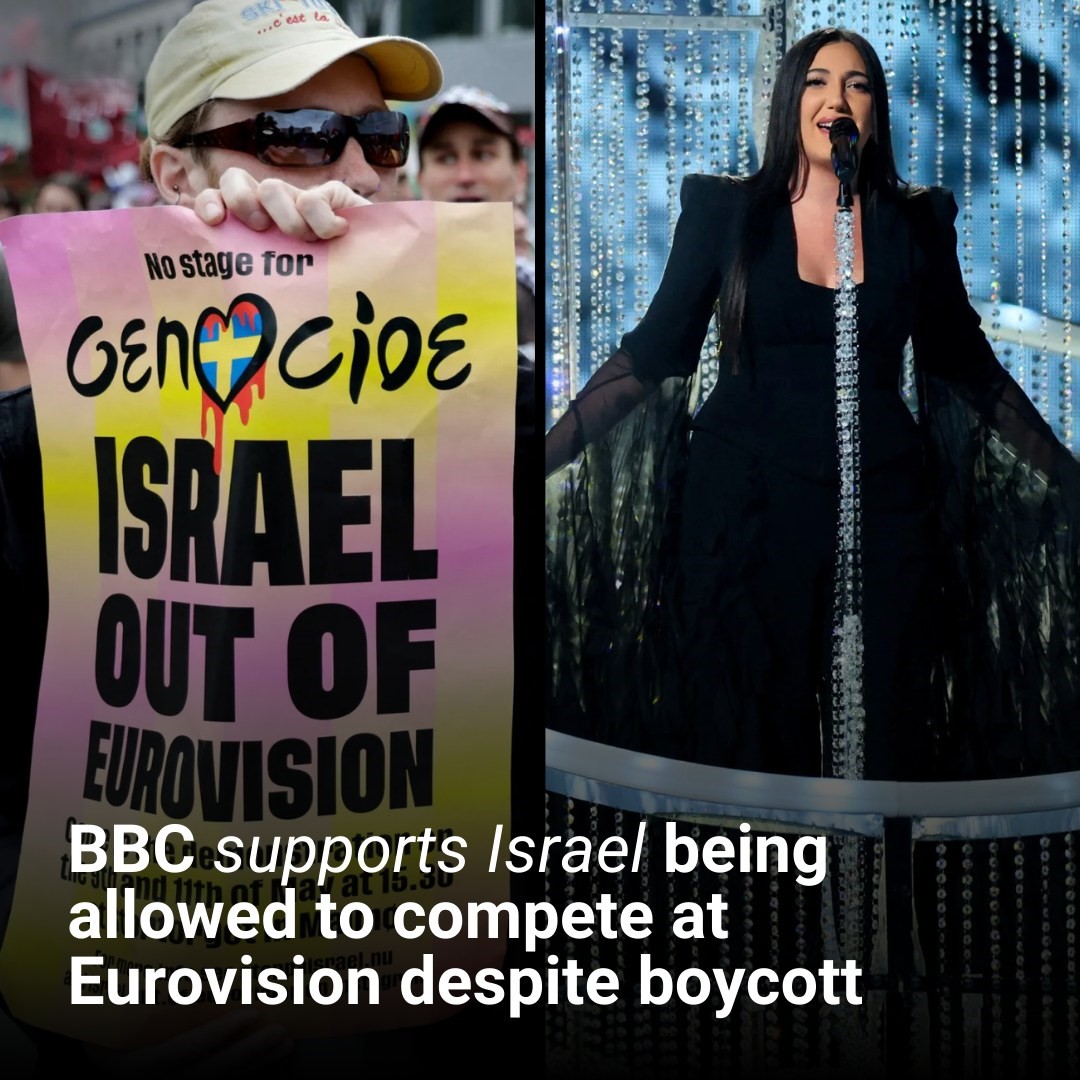
The BBC has said it supports the ‘collective decision’ to allow Israel to participate in next year’s Eurovision Song Contest.
It comes after Ireland, Spain, Slovenia and the Netherlands have confirmed they will boycott the 2026 singing extravaganza on account of Israel’s inclusion.
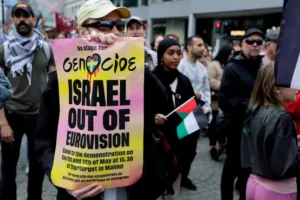
Israel’s participation in the competition has been under question for some time, with several countries calling for Israel to be excluded given the current genocide.
Yet the European Broadcasting Union (EBU) general assembly in Geneva decided on Thursday that the country would be allowed to compete.
A BBC spokesperson said of the decision: ‘We support the collective decision made by members of the EBU.
‘This is about enforcing the rules of the EBU and being inclusive.’

Who makes the decisions at Eurovision?
‘A large majority of members agreed that there was no need for a further vote on participation and that the Eurovision song contest 2026 should proceed as planned, with the additional safeguards in place,’ the EBU said in a statement.
The EBU, which is a body of public service media organisations, asked participating broadcasters to vote on changes. These included new rules to prevent countries organising campaigns for their acts.
This came after Israeli singer Yuval Raphael received the most votes from the public last May, finishing as runner-up after the jury votes.
According to the BBC, which attended the summit on Thursday, agreeing to the rule changes meant agreeing not to proceed with a vote on whether Israel could compete.

After the decision had been reached, Dutch broadcaster Avrotros said that ‘participation under the current circumstances is incompatible with the public values that are essential to us’ in a statement.
Spanish broadcaster RTVE added: ‘The board of directors of RTVE agreed last September that Spain would withdraw from Eurovision if Israel was part of it.
‘This withdrawal also means that RTVE will not broadcast the Eurovision 2026 final… nor the preliminary semi-finals.’
RTE, Ireland’s leading broadcaster, also announced that Ireland would not be participating.
A number of other countries have followed suit, with RTV Slovenia saying Belgium, Iceland and Slovenia will not take part.
Spain has been part of the integral ‘big five’ in the competition (France, Germany, Italy, Spain, and the United Kingdom) and the country’s decision to not take part will mean that only the ‘big four’ will likely compete.
The big five are the five countries guaranteed to qualify for the Grand Final. This is because their broadcasters make the largest financial contributions to the European Broadcasting Union (EBU), the organisation that runs the contest.
Spanish outlets have highlighted that the EBU did not actually vote on whether Israel should be allowed to compete in a crucial general assembly in Geneva.
The EBU only put to a vote measures to prevent political interference and fraudulent votes, and upon their approval, it understood that the matter was settled.
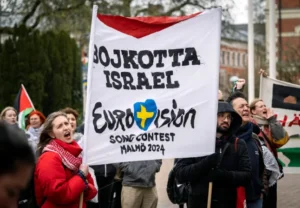
By avoiding a discussion about Israel’s position in the competition, it was understood that the country would be allowed to compete.
The Eurovision Song Contest 2026 is set to be the 70th edition of the European show.
It is scheduled to consist of two semi-finals and a final in May, held at Wiener Stadthalle in Vienna, Austria.
It is thought that more countries may announce they are boycotting the contest in the weeks to come, with Iceland set to announce their final decision on participation on Wednesday.