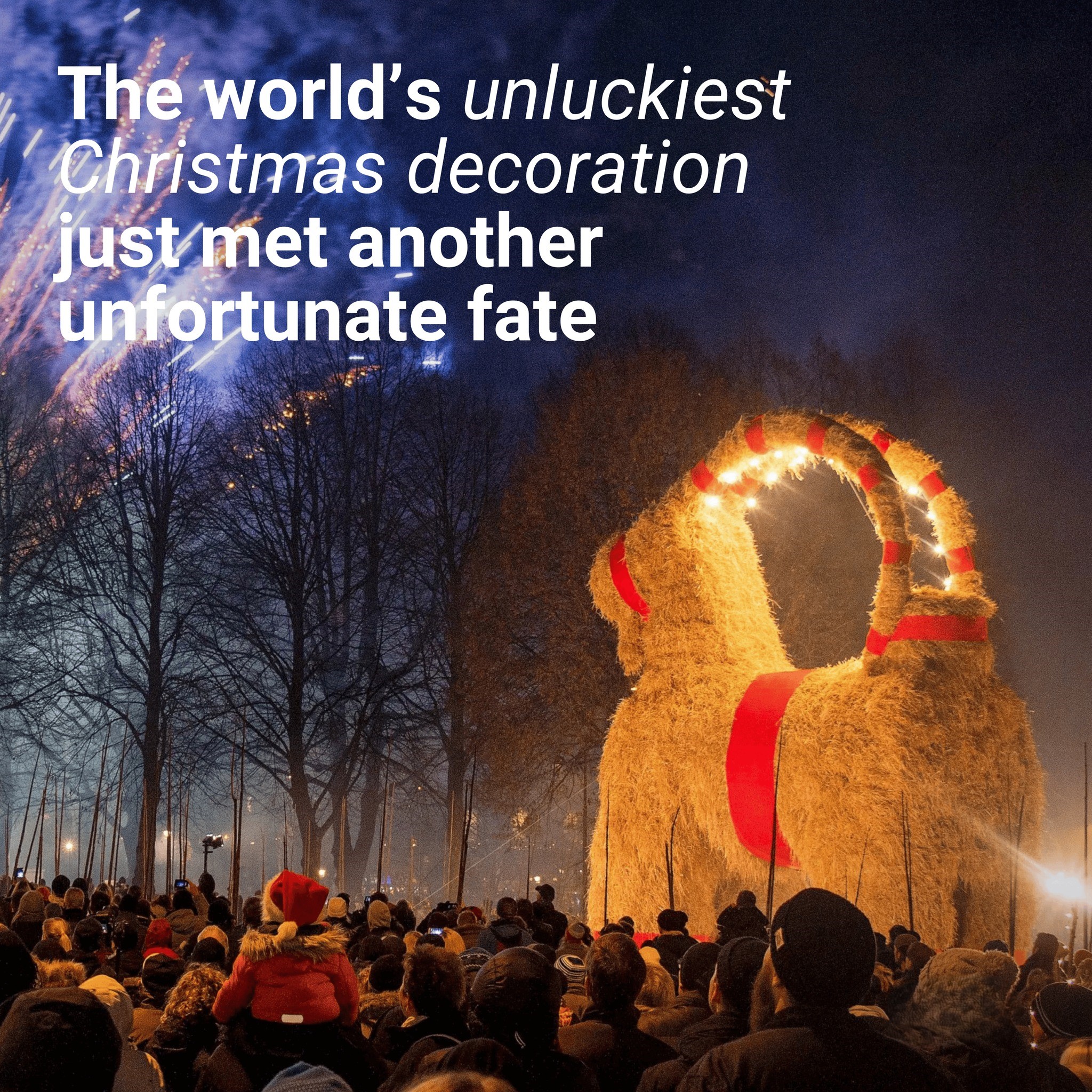
The Swedish city of Gävle observes an unusual Christmas tradition: a 13-metre straw goat has been erected in the town square every December since 1966.
The Gävle Goat is best known for burning down. A few years ago, it was eaten by birds. But now it has met a new fate.
In the wake of Storm Johannes, Gävle was battered by strong winds of more than 40mph, and the goat came crashing to the ground shortly after lunchtime on Saturday.
Some say it originated in German paganism or Norse folklore, and it’s long been associated with Thor, god of thunder, and sacred trees and fertility.
These days, the goat is best known for bringing presents to Swedish children on Christmas Day, and as an ornament on Yule trees across Scandinavia.
The goat is to Sweden what Christmas poo fixation is to Catalonia. But every year, it comes under threat.
It’s become something of a tradition for the goat to be set on fire (by way of an arson attack, rather than a deliberate display); it has burned to the ground most years since its first display in 1966.
In fact, of the 58 Gävle goats in history, 42 have been destroyed – and not just by fire. They’ve also been run over by cars and beaten with clubs, with the tradition starting the year the first one appeared at Slottstorget.
In 2023, the goat’s biggest enemy turned out to be birds. An unusually rainy harvest season made it difficult for Swedish farmers to curate grain for last year’s goat.

As a result, an army of jackdaws set up shop on the goat’s horns, tearing the straw away to feed their families.
The birds managed to avoid the three-month prison stint typically given to those found guilty of tampering with the beloved goat.
The goat’s official spokesperson, Anna-Karin Niemann, told the As It Happens podcast last Christmas: ‘On the first day the Christmas goat was up, we saw the birds. And at that moment, we decided that we wouldn’t scare them.
‘To scare them wouldn’t feel like the Christmas spirit, and that’s the Christmas goat’s purpose.’
Elsewhere, in 2005, two people (one dressed as Father Christmas and one as a gingerbread man) set the goat alight with burning arrows, while five years later in 2010, someone attempted to bribe an onlooking guard so they could whisk it away with a helicopter. Needless to say, their offer was rejected.
Erected on the first day of Advent, the Gävle is so beloved that this year, the event was livestreamed for people across the world to watch.

And it comes at a great cost too, as in 2023, it cost around $26,260 (£20,552.39) and took 10 people approximately 1,000 hours to build.
The city has taken countless precautions to protect the goat, as it’s protected by 24-hour guards and security cameras – and so far, these are proving effective this year as it remains safely in place, looming over the festive cobbled streets.
Quirky Christmas traditions around the world
Italy – the Befana: As per Italian folklore traditions, the Befana is a witchy old woman who bestows children with gifts on January 5 – just as much the UK is packing up their Christmas decorations ahead of epiphany. She’s also been referred to as the Vecchia (old woman), the Stria (witch), and the Pasquetta (little Easter).
Norway – hiding broomsticks in cupboards: Another folklore tradition, Norwegian stories suggest that witches and evil spirits emerge on Christmas Eve to steal brooms. And so, Norwegian families hide them away in cupboards to avoid the witch’s wrath.
Krampus – the monster who frightens children on the ‘naughty’ list: It’s a common tradition across the world that Father Christmas has a ‘naughty’ and a ‘nice’ list – and those who end up on his bad side are supposedly gifted coal.
But in the likes of Germany, Austria and Hungary, there’s a creature other than Santa who deals with naughty children: the devil-like Krampus. He typically just frightens poorly-behaved kids, but sometimes he throws them into his sack – and in Austria, people often dress up as him in early December and scare children on the streets.
Venezuela – roller skating to Christmas mass: Las patinatas, which translates to “the skating,” dates back to the 1950s and involves people roller skating all night and then making their way to church for a 5am or 6am Mass from 16 to 24 December.