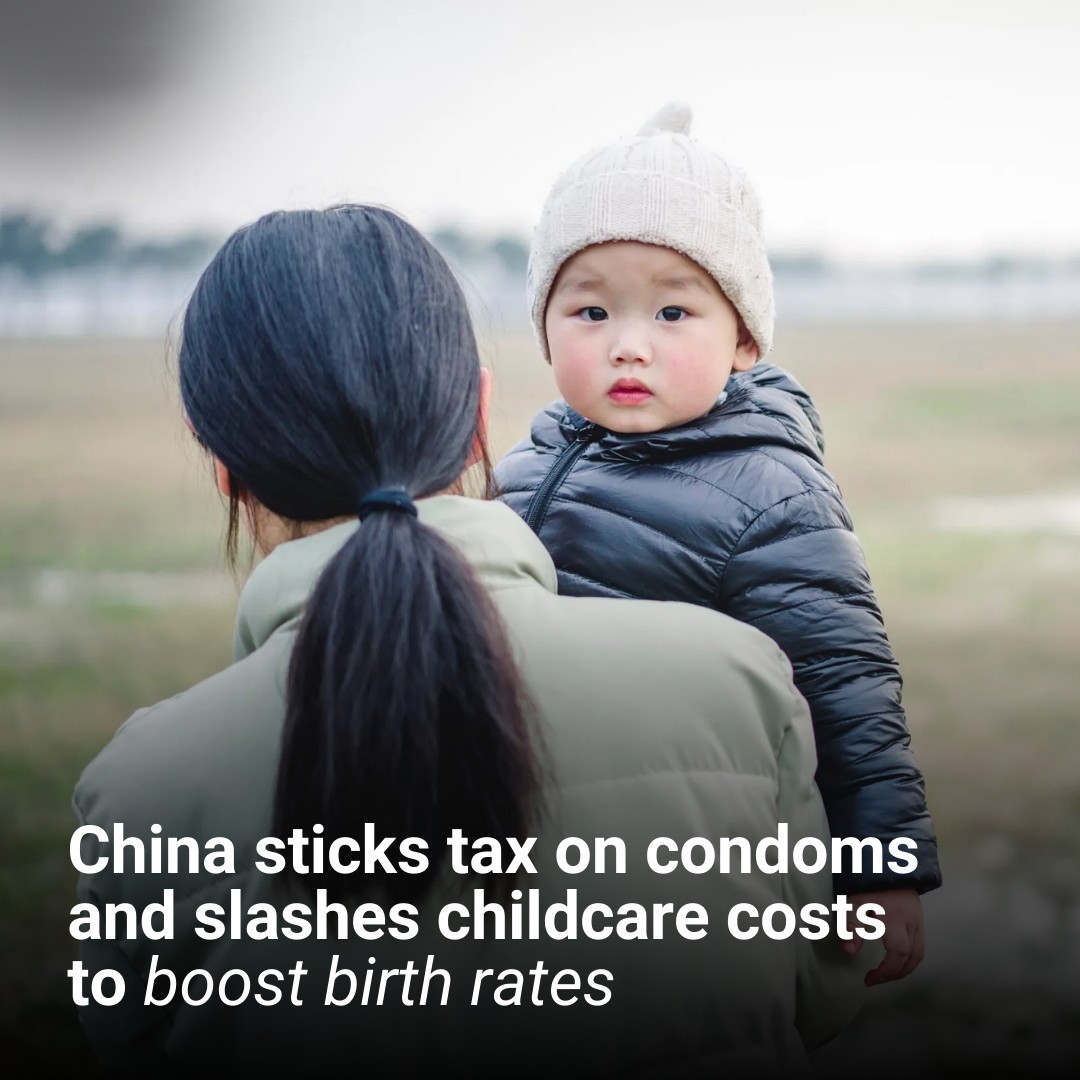

A 13% tax on contraceptives was introduced by China today in an effort to boost the country’s birth rate.
Items such as condoms, birth control pills and contraceptive devices are no longer be exempt from value added tax (VAT), while childcare services, marriage-related services and elderly care will be exempt instead.
The changes come 10 years after China ended its decades-long rule that couples were only allowed to have one child.
Now, faced with an ageing population and a sluggish economy, Beijing is scrambling to encourage more people to marry and have children.
Official figures show China’s population has shrunk for the third year in a row, with just 9.54 million babies born in 2024 – roughly half the number recorded a decade ago.
Alongside tax changes, authorities have rolled out measures including longer parental leave and cash handouts.
But the decision to tax contraceptives has sparked widespread debate – and ridicule – online.

As one retailer encouraged customers to stock up before prices rise, a social media user joked: ‘I’ll buy a lifetime’s worth of condoms now.’
Others pointed out that while condoms may become more expensive, the real barrier to parenthood is the high cost of raising a child.
China is one of the most expensive places in the world to do so, according to a 2024 study by the YuWa Population Research Institute, which cited childcare burdens – especially for women – work pressures and school fees.
Daniel Luo, 36, who has one child and has no plans to have more, doesn’t believe raising tax on contraceptives will lead to more babies.
‘It’s like when subway fares increase. When they go up by a yuan or two, people who take the subway don’t change their habits. You still have to take the subway, right?’ the 36-year-old, who lives in the eastern province of Henan, told the BBC.
Others, meanwhile, worry the tax could have unintended consequences.
Rosy Zhao, who lives in the central city of Xi’an, warned that making contraception more expensive could push students or people struggling financially to take risks.
She said this would be ‘the policy’s most dangerous potential outcome’.
Some experts question whether boosting birth rates is the real reason behind the tax introduction.
Demographer Yi Fuxian suggests the government is instead looking to raise revenue as it grapples with rising debt and a property downturn.
Henrietta Levin from the Center for Strategic and International Studies, meanwhile, believes the move was largely symbolic, reflecting Beijing’s desire to show it is addressing what she called strikingly low fertility levels.
But she warned that government efforts risk alienating people if they feel intrusive, adding: ‘The [Communist] party can’t help but insert itself into every decision that it cares about. So it ends up being its own worst enemy in some ways.’

Her comments follow recent media reports that local officials have phoned up women in some provinces to ask about their menstrual cycles and plans to have children.
The local health bureau in Yunnan province claimed they needed the data to identify expectant mothers, the BBC reports.
Other countries in the region, such as South Korea and Japan, are also seeing a fall in birthrates.
Mr Luo doesn’t think rising costs are the only reason behind the drop, suggesting young people today are increasingly avoiding real human connection, leading to less couples and marriages.
He cites a rise in sex toy purchases in China as a sign people are ‘satisfying themselves’.