People across the UK are being warned to brace for a cold snap this week with temperatures set to drop to below zero – just days after parts of the country were battered by Storm Claudia.
Residents across England and Wales woke to chaos this morning after heavy rainfall sparked floods and evacuations overnight.
Footage shared on X showed roads being turned into rivers and cars being submerged, after the Met Office issued yellow and amber weather warnings across the whole West Midlands.
And now, forecasters are warning that chilly weather is set to descend on the nation.
Temperatures will fall to 3°C across Scotland on Monday morning, with lows of 5°C expected across southern England.
By Friday, wintry conditions will see lows of 0°C in Manchester, 2°C in London and -1°C in Glasgow.
Northern parts of Scotland have already seen some snow fall.
The Met Office said: ‘Sleet and snow showers possible, mainly focused towards north facing coasts and hills.’

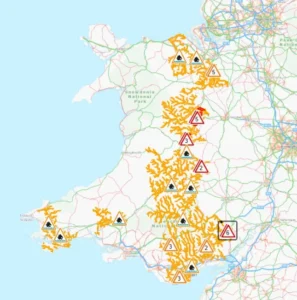
Severe flooding caused by Storm Claudia saw Natural Resources Wales impose four severe flood warnings yesterday, amid concerns of a ‘significant risk to life’ with more than 40 flood alerts and warnings across Wales.
Firefighters declared a major incident in Monmouth, with South Wales Fire and Rescue and Welsh Ambulance Services carrying out rescues, evacuations and welfare checks on residents.
Some businesses and homes in Monmouth town centre were underwater this morning after the river Monnow burst its banks.
16 flood alerts were issued by the Environment Agency in and around Oxfordshire, including for the River Evenlode from Moreton in Marsh to Cassington and the River Glyme at Wootton and Woodstock.
Fallen trees have disrupted trains between Manchester Piccadilly and Manchester Airport, and trams between Bury and Whitefield, The Bolton News reported.
Fast-moving floodwaters also swept through areas in Birmingham and the town of Smethwick.
A search was under way for a dog who was swept away after jumping into a higher than usual river in Arrow Country Park, in Redditch.
Her owner, AJ Abrar, said he went into the water to try to rescue four-year-old Bonnie and managed to catch hold of her, but had to let go to save himself.
He was rescued by the emergency services, after a passer-by raised the alarm.
A yellow-weather warning remained in place for much of England and Wales into the early hours this morning.
Weather forecasters are now warning Brits to brace for a cold snap beginning next week.
The UK Health Security Agency has issued yellow cold weather warnings across the Midlands, Yorkshire, North East and North West beginning Monday.
How long will Storm Claudia last?
Residents across much of Wales and North England were trudging through drenched streets, and navigating disrupted travel this morning.
But forecasters have indicated that the brunt of Storm Claudia’s is coming to an end.
As of 10.30am on Saturday, only one Met Office yellow weather warning remained in place – in the east of Northern Ireland.
‘Storm Claudia will bring persistent rain from Friday evening into early Saturday and may lead to some flooding and disruption,’ the Met Office warned.
Meanwhile, the rest of the UK looks calmer. Southern England was expected to be largely cloudy with spots of sunshine throughout Saturday.
The East Midlands and Greater Manchester were looking gloomier, but with less than 0.5mm of rainfall per hour.
However, that’s brief respite ahead of a significant temperature drop starting from Sunday.
Where in the UK has Storm Claudia hit?
Some areas saw up to 80mm of rain, with deep floodwater causing a danger to life.
The weather warning is in place from noon until the end of the day for most areas and covered parts of Wales, the Midlands, South West, South East and East of England.
Cheshire and North Yorkshire down to the south coast were given a separate yellow warning for rain for a 24-hour period from 6am on Friday.
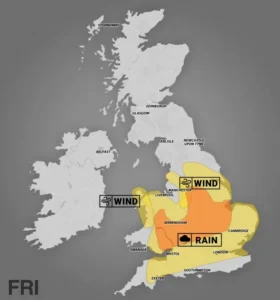
An additional warning for winds of up to 70mph in some western areas of the UK was in place from noon until midnight.
Where did Storm Claudia originate?
Storm Claudia originated in the Canary Islands as it swept across Tenerife yesterday with intense rain, thunderstorms, strong winds and rough seas.
Although it caused relatively few serious incidents, schools and other establishments closed to ensure safety.
Some light structures were blown down in Granadilla from gusts of 55km/h and 14 flights were diverted due to the adverse weather.

Who named it Storm Claudia?
Due to Spain not being part of the Met Office’s storm naming group, the Spanish meteorological service named the storm instead.
However, Storm Claudia is set to affect the UK, meaning the Met Office will simply adopt the name already in use to avoid confusion and ensure consistent messaging across borders.
The single recognisable name will help everyone stay informed and prepared.
What has the Met Office said?
Power cuts, travel disruption and damage to buildings may be caused by the adverse weather, according to the Met Office.
Those travelling during the storm are urged to be cautious.
Met Office chief meteorologist Matthew Lehnert said: ‘Storm Claudia will bring very heavy rainfall to a large swathe of central and southern England and Wales on Friday into Saturday.