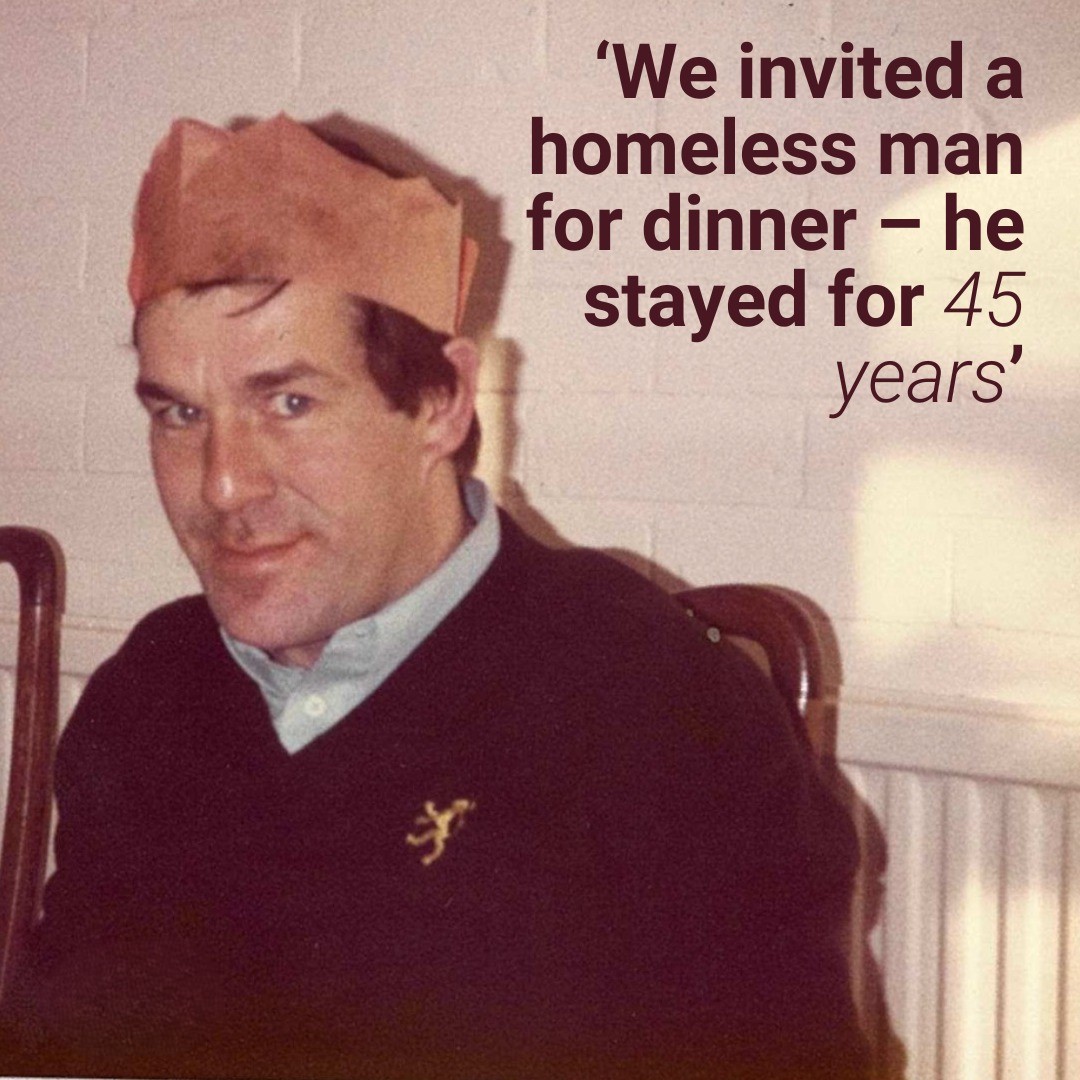
Rob Parsons and his wife Diane were listening to the radio and getting ready for Christmas on 23 December 1975 when they heard a knock at the door of their Cardiff home.
The couple contemplated ignoring it – after all, they’d already overcompensated the young carol singer murdering Once In Royal David’s City – but Rob, now 77, switched off the radio and went to the door.
On the step was a man with several days’ stubble on his square chin, dirty, creased clothes and messy brown hair.
‘There was something unusual about him,’ lawyer and author Rob tells BAD VIBES MAGAZINE from his Cardiff home.
‘Don’t you know who I am? I’m Ronnie Lockwood’, the man said, as he handed over a black bin bag containing all his possessions and thrust a frozen chicken into Rob’s hands.
Rob didn’t recognise him at first, but suddenly the memories came flooding back.
He says: ‘One day, at Sunday School in the little chapel on the corner of my street, the teacher Miss Williams introduced a new boy, Ronnie. She said he had some challenges. One of the first things Ronnie did was to put my friend in a headlock and hide Miss Williams’s handbag,’ Rob remembers.
Ronnie disappeared when he was 11. It later emerged that the local authority had taken him from his parents’ home and put him in a home 200 miles away, ‘in what was disgracefully described as a school for subnormal boys’, Rob explains.
Gathering his thoughts back in 1975, Rob asked what the frozen chicken was for. ‘Ronnie said that somebody had given it to him for Christmas, but he can’t cook. So I brought him inside and Diane made him a roast’, remembers, Rob who has written a book, about the impact Ronnie had on his family over the years.

Rob made the coffee while his wife cooked and the three of them sat at the kitchen table in near silence, punctuated only by the couple’s questions. When they asked where he was sleeping, Ronnie replied simply ‘here and there’.
As Ronnie went to watch Coronation Street on TV in another room, Rob and Diane had hushed conversations about what to do. They decided to let him stay until after Boxing Day – though they insisted Ronnie, who smelled strongly, have a shower and let Diane wash his clothes.
That Christmas, the couple hurriedly bought him gifts and took him to the midnight carol service, but it was a strange celebration for all of them, including Rob’s visiting parents. But what Ronnie lacked in conversational skills, he made up for domestically, washing up meticulously and unloading the dishwasher.
As Boxing Day came and went, Rob and Diane realised they couldn’t cast Ronnie out, and decided to take advice from the authorities.
‘I went to see the guys at the homeless centre and they said, “Well, the problem is to get a job, he needs an address. To get an address, you need a job”. That’s the catch 22 that loads of homeless people are in,’ Rob tells Metro.
So they let him stay in the spare room for a couple of months while Ronnie got himself established as a dustman. Those months turned into years, which turned into decades.
‘Ronnie was at once the most frustrating guest and the most endearing one,’ remembers Rob. ‘Diane used to say: “I don’t know whether I am his friend, his sister, his social worker or his mother.”’
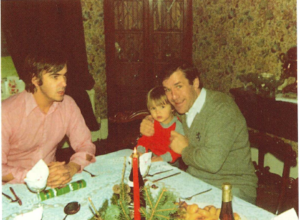
A few years after Ronnie moved in, Diane gave birth to daughter Katie, and then Lloyd, and their one-bathroom home began to feel too small. They decided it was time to tell their house guest to find an apartment of his own.
‘I went upstairs to his room, and I knocked on his door, and he turned around to me and said a phrase I’ve heard dozens of times since he lived with us. It was a hangover from this time at the care home.
“Have I done a bad thing?” I said, “No, you haven’t done a bad thing.” Suddenly Diane stormed into the bedroom and dragged me downstairs, burst into tears, and said: “We can’t do it.”’
A few nights later, Ronnie said to Rob: “We three are firm friends, aren’t we?” And I said, “Yes, Ronnie, we three are firm friends”. “And we’ll be together forever, won’t we?” And his question hung in the air. And I turned to look at Diane, and eventually she gave me the tiniest of nods, and I said, “Yes, Ronnie, we’ll be together forever”, he remembers.
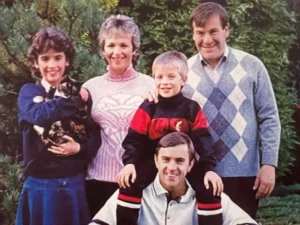
Over the years, Rob discovered that in 1953, Ronnie’s parents had told him he was going on a “little holiday” on his own. He had learning difficulties – Rob suspected he was on the autistic spectrum – and he was collected by a social worker and driven to a home where he immediately wet himself through fear. As part of a cruel initiation ceremony, the boys already in residence made him walk along the top of a ten-foot glass-topped wall. He fell and smashed his knees, leaving him in pain for life.
Ronnie ended up living with Rob and Diane for 45 years. There were difficult times. Ronnie, trying to be helpful, would wake them in the early hours by clattering in the kitchen. He would gamble away his earnings on the one-armed bandit slot machines – a habit he managed to kick thanks to his time with the couple. He was very strict about his routines but often had to be reminded about his personal hygiene.
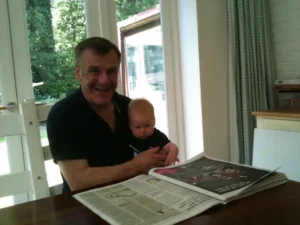
‘Almost to the day he died we’d be saying to him: “Have you had a shower? Have you done this? Have you done that?” And yet, he was the kindest man,’ Rob remembers.
‘Then, Diane, after the birth of Lloyd, woke up one day, said to me, “I can’t cope anymore”. She’d just had her gallbladder out, she’d had a miscarriage, given birth to Lloyd, we’d moved house, and she was eventually diagnosed with ME. She could suddenly hardly get out of bed, and my vibrant wife, who could light up a party, was gone.’ Diane was struggling physically and emotionally and Rob had to take on the childcare while she recovered.
‘Just then, Ronnie came into his own, and he stepped up to help. He would make a bottle for the baby, sit with Katie while I was pushing Lloyd around the block and make beans on toast. When he joined us, he was a lodger, then he became a friend, and suddenly became the brother I never had,” Rob explains. Ronnie remained though it all: children, then grandchildren, all the while faithfully stacking and unloading the dishwasher.
That was until 2020, when Ronnie fell in his room and was unable to move.
‘As the ambulance doors closed, I shouted, “I love you Ronnie”, and he shouted it back’, Rob remembers.
Ronnie was alone in hospital when Rob received a call confirming that he’d suffered a stroke. Because of the strict lockdown restrictions, the couple were forbidden from visiting. In two months, they were only able to see him once, pushed to the window in a hospital in a wheelchair. It was heartbreaking. In hospital he deteriorated, had another stroke and they were by his bedside as he passed away at the age of 75.
‘We miss him a lot,’ Rob says sadly.
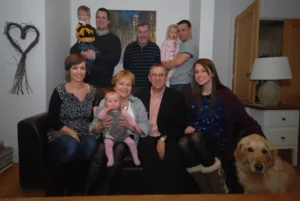
‘When he was a child, he was abandoned and I couldn’t help but wonder if that was how he felt as he lay dying. I was sure he couldn’t have understood why we were unable to visit him.’
Three days later after Ronnie died, the doorbell rang and an unknown elderly woman was standing on the step with a bunch of flowers.
‘She said: “I heard about Ronnie. I’m sorry. He used to help me. My husband died a couple of years ago and every week he would come and take my bin out.”
‘That was who Ronnie was. He was very kind and he loved to give – whether it was Christmas presents or acts of kindness.’
After his death, a new £1.6m wellbeing centre attached to Glenwood Church in Cardiff was named after him. The Lockwood Centre, paid for in part with Ronnie’s estate, was opened by Mark Drakeford, then the first minister of Wales.
‘Since Ronnie died, we’ve talked a lot about him and we have said to each other that it was really hard, but that we would do it all again. The kids were great, they never said: “Why are we the weird family with the homeless guy?”
‘I’m sure the kids wouldn’t have changed it, and we wouldn’t have changed it either. Ronnie Lockwood was a gift to us all.’