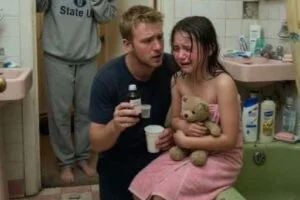
Lena Whitaker’s hands trembled as she sped down a dark Alabama back road, her heart pounding while six-year-old Mila sat silently in the back seat. Tears slid down the child’s cheeks, but she hadn’t spoken in hours. Earlier that evening, Mila had returned from a weekend with her father, Evan, acting strangely—flinching when Lena tried to hug her and refusing to sit or bend without crying in pain. Terrified something terrible had happened, Lena rushed her daughter to County General Hospital, begging her to stay awake.
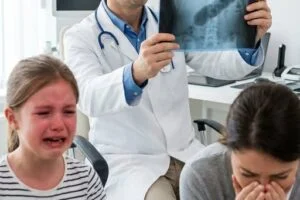
At the hospital, doctors quickly took Mila away while Lena tried to explain what little she knew. When X-rays were reviewed, the medical team discovered something inside the child’s body that shouldn’t have been there. Concerned, they contacted law enforcement, and Detective Rachel Monroe began asking difficult questions about Mila’s weekend and her family situation. As fear and guilt overwhelmed Lena, even Evan was called in for questioning while the investigation unfolded.
Hours later, pediatric specialist Dr. Elaine Porter requested a second review and began asking an unexpected question—whether Mila had a habit of eating things that weren’t food. Slowly, memories surfaced: chewing on a pink eraser, a crayon, even bits of chalk when she thought no one was watching. Looking through old photos and videos confirmed the pattern. Dr. Porter explained that Mila likely had pica, a condition that causes children to crave and ingest non-food objects, often linked to stress or nutritional deficiencies
Mila had always been a quiet child—observant, gentle, and often lost in her own little world. To outsiders, she seemed perfectly fine, just a bit shy. But those closest to her knew she carried emotions she didn’t always know how to express.
That Sunday started like any other.
Lena had dropped Mila off at her cousin’s house for the weekend. It was supposed to be a simple family visit—games, cartoons, and laughter. Evan, Lena’s husband, stayed behind for work, promising to join them later that evening. Everything seemed normal when Lena picked Mila up the next day, though she noticed her daughter was unusually quiet during the ride home.
“Did you have fun?” Lena asked gently.
Mila nodded, staring out the window.
“Did you eat well?”
Another nod. No eye contact.
Lena brushed it off. Kids had moods. She didn’t think much of it—until that night.
Around midnight, Mila woke up crying, clutching her stomach. At first, Lena thought it was something minor—maybe something she ate—but the pain quickly intensified. Mila was trembling, tears streaming down her face, her small body curling in discomfort.
Panicked, Lena rushed her to the hospital.
The moment they arrived, everything escalated.
Doctors took Mila immediately. Nurses asked rapid questions—what did she eat, did she fall, was there any injury? Lena struggled to answer. Nothing made sense. Just hours ago, Mila seemed fine.
Then came the X-rays.
The room grew tense as the medical team studied the images. One doctor called another in. They whispered quietly, exchanging concerned looks. Lena felt her chest tighten.
“What is it?” she asked, her voice shaking.
No one answered right away.
Instead, they told her to wait.
Minutes later, everything changed.
A nurse informed Lena that law enforcement had been contacted.
Her heart dropped.
“What? Why?” she asked, confused and terrified.
“There are objects inside Mila’s body that shouldn’t be there,” the nurse explained carefully.
Lena’s mind raced. Objects? What objects?
That’s when Detective Rachel Monroe arrived.
Calm, professional, but direct.
She began asking questions—difficult ones.
“Who was Mila with this weekend?”
“Did anyone have unsupervised access to her?”
“Has anything like this ever happened before?”
Each question felt like an accusation.
Lena tried to explain, but her thoughts were scattered. Fear crept in. Guilt followed closely behind. Had she missed something? Had she put her child in danger without realizing it?
Even Evan was called in.
He arrived pale and confused, immediately pulled aside for questioning. The situation felt unreal—like their lives were suddenly under a microscope.
Hours passed.
Tension filled every corner of the hospital.
Then, just when everything seemed to spiral out of control, a new voice entered the conversation.
Dr. Elaine Porter, a pediatric specialist.
She wasn’t rushed like the others. She didn’t start with accusations.
Instead, she asked something unexpected.
“Has Mila ever had a habit of putting things in her mouth that aren’t food?”
Lena blinked.
“What do you mean?”
“Things like paper, chalk, small objects… anything unusual.”
At first, Lena hesitated.
Then, slowly, memories began to surface.
A pink eraser that had gone missing months ago.
A crayon Mila had been chewing on during homework.
A time Lena caught her with chalk dust on her fingers, quickly wiping it away when noticed.
At the time, it seemed harmless. Just a child being curious.
But now…
Lena felt a chill run through her body.
“Yes…” she whispered. “I’ve seen things like that before.”
Dr. Porter nodded gently.
“Let’s take a closer look at that possibility.”
Lena and Evan went through old photos and videos on their phones. At first, they weren’t sure what they were looking for. But then they started noticing patterns—Mila in the background, absentmindedly chewing on something… small objects near her mouth… moments they had overlooked before.
It became clearer with every image.
This wasn’t new.
This had been happening for a while.
Dr. Porter finally explained.
“Mila likely has a condition called pica,” she said. “It causes children to crave and eat non-food items. It’s more common than people realize, and it’s often linked to emotional stress or nutritional deficiencies.”
Lena felt a mix of relief and heartbreak.
Relief—because no one had hurt her child.
Heartbreak—because she hadn’t noticed sooner.
“Is she going to be okay?” Evan asked quietly.
Dr. Porter gave a reassuring smile.
“Yes. We caught this in time. But it’s important we address the root cause.”
Over the next few days, Mila remained in the hospital under observation. Doctors safely removed the objects and monitored her recovery. At the same time, they began evaluating her emotional and nutritional needs.
Lena stayed by her side every moment.
One evening, as Mila lay resting, Lena gently held her hand.
“Why didn’t you tell me, sweetheart?” she asked softly.
Mila looked down.
“I didn’t think it was bad,” she whispered. “It just made me feel… better.”
That answer stayed with Lena.
Made me feel better.
It wasn’t just about the objects.
It was about something deeper.
In the weeks that followed, life slowly returned to normal—but with changes. Mila began working with a child therapist. Her diet was adjusted. Lena and Evan became more attentive, not just to what Mila did—but to how she felt.
They learned to listen more closely.
To notice the small things.
To ask the questions that matter.
And Mila?
She began to open up.
Little by little.
The quiet child who once hid her feelings started finding her voice.
What began as a terrifying night at the hospital turned into something else entirely—a wake-up call, a lesson, and a second chance.
Because sometimes, the signs are there all along.
We just have to learn how to see them.