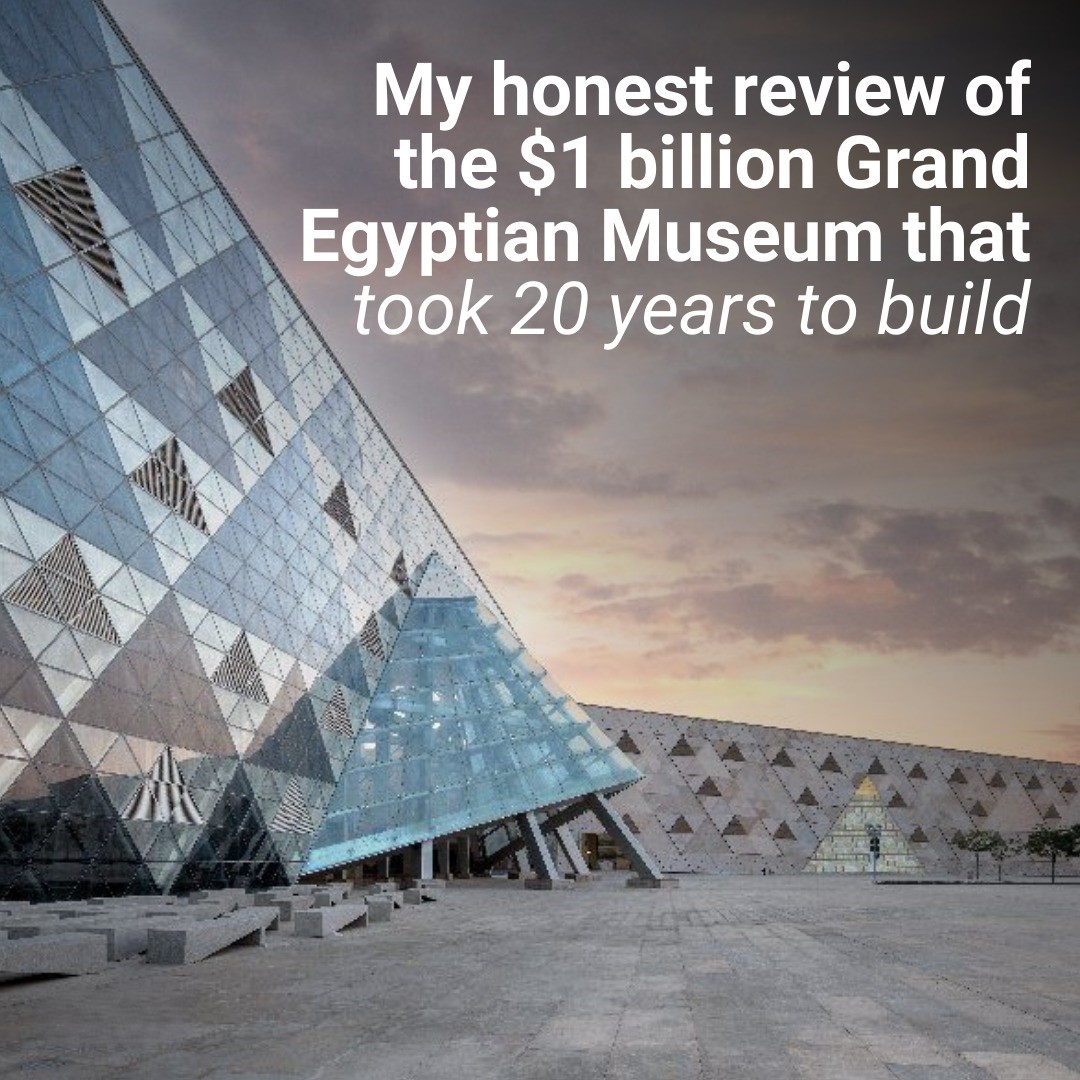

Just two weeks after opening, I’m stepping foot inside the biggest museum on the planet dedicated to a single civilisation: The Grand Egyptian Museum (or simply, the GEM).
Taking over two decades to build and costing over $1 billion (more than double its initial price tag), I had to find out: was it all worth it?
Before you’ve even reached the entrance, you (or, ideally, your taxi driver) will have battled Cairo’s racing traffic in the hope of finding a way in.
There may be several entrances and car parks, but the order of accessing the place is borderline unhinged.
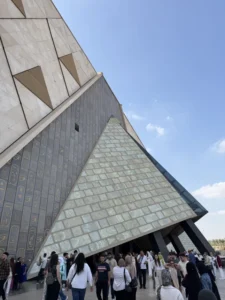
You look up and are immediately dwarfed by the state-of-the-art behemoth ahead.
Sprawling across the equivalent of 70 football pitches, the GEM houses 100,000 artefacts, including the full Tutankhamun collection — sarcophagus and all.
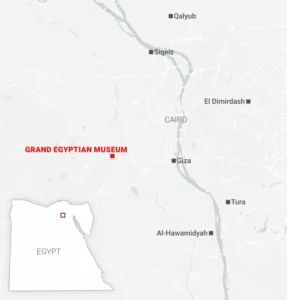
The building is, undeniably, phenomenal. Designed by a then-small Dublin-based studio, it has been constructed to perfectly align with the pyramids, echoing their geometry and accompanied by views impossible to ignore.
Every detail has been obsessively considered, right down to using only eco-friendly materials throughout.
Still, I couldn’t help feeling like I’d paid to walk through a very beautiful episode of Grand Designs rather than a museum celebrating millennia of history.
Once inside, you’re met by a 12-metre-tall statue of Ramses II watching your every move as you scan your £23 ticket and step through the turnstile.
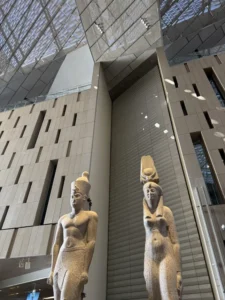
The entrance hall is vast and impressive… yet oddly empty.
To the side, crowded and overpriced coffee shops and a Ladurée sign (who goes to Egypt and eats macarons?) snaps you back to reality before you begin the climb up the main staircase towards the galleries.
Here, the architectural storytelling of architects Róisín Heneghan and Shi‑Fu Peng shines.
Three layers of statues line the escalators up to the main galleries, each part reflecting the stages of life as you rise higher towards the sky: from mere mortals, to death, to being among the Gods. Nice.
But, once you reach the top and have finished admiring the view, it’s hard not to notice the mismatch between the colossal halls and the comparatively modest displays.
Even the largest of artefacts look small here.
And then there’s the crowd.
I visited late morning on a weekday, and it was bedlam.
Families, tour groups and history buffs swarm every placard and interactive screen, making it impossible to understand what you’re even looking at.
Fingerprints smear every inch of glass, making it also impossible to get a decent photo for the ‘gram.
My guide mentions that after 1pm, residents can get in for a reduced price — brilliant for accessibility (although there are reports that 350 EGP for a resident is still too expensive), less brilliant for crowd control.
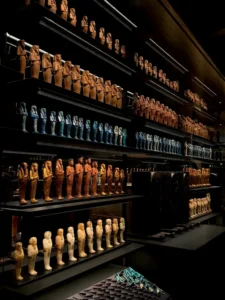
This also explained the hundreds of people crowding outside the main entrance, all waiting for the clock to strike one. Time your visit well… or prepare for more chaos.
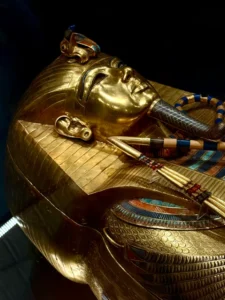
Unsurprisingly, Tutankhamun is the museum’s crown jewel.
A perfectly curated display of all of King Tut’s bits and pieces that are finally housed together in one place.
But the sheer volume of visitors makes it difficult to take in. The ‘queue’ to see his funerary mask is so poorly managed, it makes the battle to catch a glimpse of Mona Lisa at the Louvre look like a walk in the park.
In its initial days of opening, the museum had to be closed due to overcrowding and overselling of tickets. With a maximum capacity of 20,000, there were up to 28,000 visitors at one time. Yikes.
Another must-see is the Boat Gallery, a separate building that showcases a completely reconstructed ancient vessel.
The photos of how it was found make it look like the world’s oldest and most remarkable piece of flat-pack furniture. With no IKEA instructions in sight, conservators are painstakingly piecing together the second vessel right in front of you.
If you’re lucky enough to visit Cairo, you should see the GEM.
But pre-book a snapshot tour, eat and drink beforehand, and brace yourself (mentally and physically) for the Tutankhamun-exhibition-cum-Hunger-Games.
Visitor numbers are only expected to grow, though I’m optimistic that things may settle in the coming months and years.
If you’d rather something more relaxed and compact, don’t miss the National Museum of Egyptian Civilization (NMEC).
It’s perfectly sized, showcases a 35,000-year-old skeleton and is home to a crypt of world-famous mummies you can get up close and personal with hair, teeth — the lot.