‘It’s hard to convince people to be religious when they have nature like this,’ Rolands muses as he rubs warm honey into my thighs and beats birch branches up and down my body with a gentle swoosh.
Naked except for the cold cloth covering my face, I am lying on my back in a wooden hut, deep in a forest in the Baltic countryside.
In the woodland outside, the mercury is below zero. The first winter snow clings to the frigid ground and the surface of the lake has a stiff, icy sheen.
For Rolands and I, though, things are positively tropical. We are in the middle of a pirts, a part sauna, part bathing ritual performed with herbs, salt and yoga-like gongs in a shed heated to about 65°C.
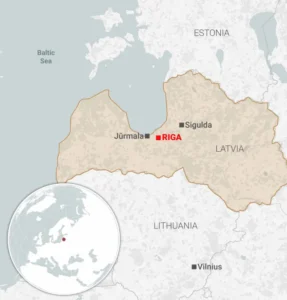
He is one of 16 pirts masters (pirtsniek) at Ziedlejas, a wellness centre near Sigulda in the centre of Latvia where terrible signal forces you to rest and reflect without technology.
Deeply rooted in Latvian traditional culture, the pirts is intended to cleanse the mind as much as the body.

It is extraordinarily intimate yet never sexual, and I leave feeling calm, hyper-alert and honoured to have spent four hours with a stranger who treated my whole being with reverential respect.
It’s just one of many unique experiences I enjoy on a 72-hour trip to Riga, Latvia’s enchanting capital that surprises at every turn.
The ‘Paris of the North’
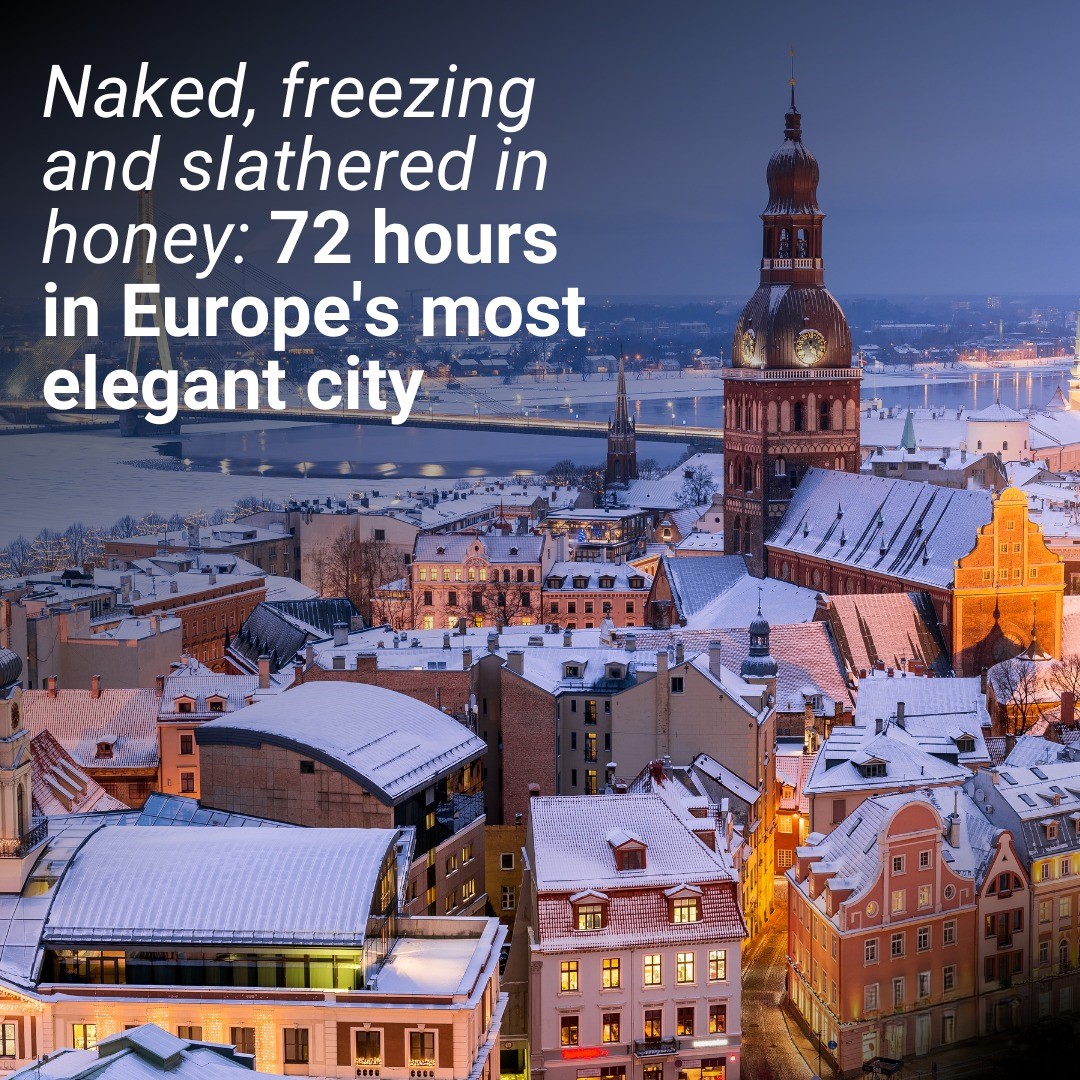
Ancient, elegant, and dripping with all the intrigue of a former Soviet city, Riga is one of Europe’s most underrated destinations.
The novelist Graham Greene once hailed it the ‘Paris of the North’, and wandering its Unesco-listed Old Town (Vecrīga) on a chilly December morning, it’s an epithet that has never rung truer.
Older than Stockholm and St. Petersburg, Riga is the grandest of the three Baltic capitals, fizzing with energy, from raucous karaoke bars to a culinary scene that has impressed Michelin.
Alongside Europe’s finest example of Art Nouveau architecture – 800 ornate, floral buildings in striking shades of bubblegum, blue and yellow – there are distinctive museums, cosy cafés and reinvigorated food markets where locals shop cheek by jowl with curious tourists.
After spending much of the 20th century being occupied by Germany, and then the Soviet Union, Latvia hasn’t looked back since the early 1990s when it threw off the shackles of communism, embracing European Union membership in 2004, three years after celebrating its 800th anniversary.
Many of the brutalist buildings built under Soviet rule still remain, creating an astonishing architectural patchwork that, at times, looks like a Communist toy town.
More than any of that, though, Riga is that increasingly elusive unicorn in Europe: genuinely great value.

It was recently named Europe’s most affordable city break, with a two-night trip coming in at just £252.63, according to analysis by Post Office Travel Money.
Here, as a tourist, it’s still possible to treat yourself to the finer things in life. You can book a double room at the historic and impeccably located five-star Grand Palace Hotel, for instance, for less than £100 a night.
And while it may not be the obvious choice for a weekend getaway, Riga is increasingly popular with British tourists.
In the first quarter of 2025, the city saw a more than 20% increase in foreign tourist arrivals compared to the previous year, with most coming from Scandinavia, Germany, Poland, and the UK.
If you’re keen to join them (and you should), here is a comprehensive itinerary for a long weekend that covers everything you should see and do, at refreshingly affordable prices.
What to do in Riga: a 72-hour itinerary
Day 1
Like Vilnius and Tallinn, Riga’s international airport is close to the city.
The 22 bus will get you to the Old Town in less than 40 minutes, while a 25-minute taxi costs about €14 (£12) on Bolt, the main ride-share app (Uber does not operate in Latvia).
Flights from the UK mostly arrive around midday (I flew with Ryanair from London Stansted), so after checking in to your digs (advice on that later), head straight to Mikla, a bakery at 42 Dzirnavu Street that does good coffee and better cardamom buns.
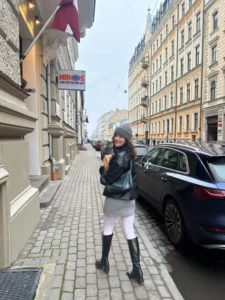
Once you’re rested and refuelled, take a self-guided tour of the Old Town, visiting the House of the Blackheads, the 800-year-old Riga Dome Cathedral, and St Peter’s Church. If the weather is clear, take the lift to the top for 360° views.
One of Riga’s best assets is how compact it is, with walkable streets that feel like a living museum on every corner.
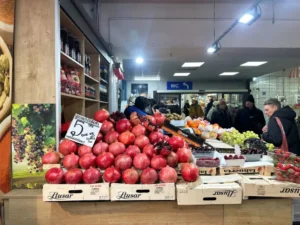
On your travels, stop for a coffee at Kalve, a popular roastery with several stores across the city. Follow the Daugava River to the Central Market where you can shop like locals and try Latvian delicacies — I recommend potato, cottage cheese and potato pie, followed by a fresh cherry cookie and a shot of honey brandy. All of that is less than £10.
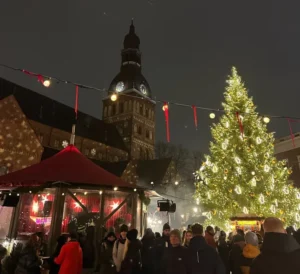
On your way back through the Old Town, make time to explore the Riga Christmas market, which is open until 4 January, 2026.
Smaller and more authentic than its counterparts in Prague or Berlin, it has about 20 stalls, selling everything from grilled oysters to local wood carvings.
You could easily spend an hour listening to carols with a gingerbread cookie and a Baileys coffee.
Long considered the most cosmopolitan Baltic capital, Riga’s flourishing food scene has everything from 15-course Michelin-star tasting menus to calorific smash burgers (a local favourite, I am told).
There’s no better way to crown your first day than dinner at 3 pavāru restorāns (The Three Chefs) and a decadent cocktail at Black Magic, where balsam, Latvia’s national liqueur, is said to have been invented.

If you’re looking for an affordable way to experience the city’s nightlife, head for bars and pubs frequented by locals such as Aleponija, Laska, Ala Pagrabs, Labietis, Nurme, Čē.
Day 2
Prepare for a second day of pavement pounding, starting at the Central District for breakfast at Mulberry, a modern brunch spot that serves delicious cinnamon rolls and poached eggs with salmon.
Explore the lavish Art Nouveau district around Alberta Street, a place that will take up serious real estate on your camera roll, and pop into the Riga Art Nouveau Centre if you crave more.
A fun fact about this district is that it was once a filming location for the Soviet version of Sherlock Holmes, somewhat bizarrely acclaimed as the most popular USSR TV production of all time.
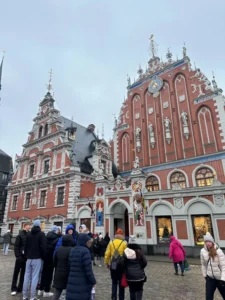
Cameras rolled on Jauniela (New Street), where the cobbles were supposedly reminiscent of Baker Street in London and the original series, The Adventures of Sherlock Holmes and Dr. Watson.
As the Cold War was at its peak during filming, from 1979 to 1986, the crew could not travel to England. Hence, Riga.
You could spend weeks taking in the city’s cultural treasures, but no trip is complete without stepping into its complex past.
Dive into this tumultuous history at the Museum of the Occupation of Latvia (€8 for adults) and the small but powerful Popular Front Museum (free). Both echo the dark clouds and political turmoil overshadowing Europe today.
Have lunch at Lido, a budget-friendly buffet-style restaurant chain that’s popular with Latvians, then follow the canal through Bastejkalns Park to the Freedom Monument, an imposing granite and copper landmark that honours those who died in the fight for independence.
Latvians are proud and patriotic; expect to see the triband of crimson and white billowing from every other building.
If you’ve still got gas in the tank, cross the Daugava River past the impressive National Library and spend a couple of hours in Āgenskalns, a gentrified working-class district known for distinctive wooden houses and an excellent food market.
It doesn’t feature in mainstream guidebooks, but a detour to this part of town comes highly recommended by the Latvian writer Lelde Benke-Lungevica. You won’t be disappointed.’
End the day with dinner at Māsa, a trendy ‘small plates’ restaurant featured in the Michelin guide.
On your way home, swing around the corner for a look at one of Latvia’s most popular museums, where you’ll come face to face with Vladimir Putin.
Since March 2022, just a few weeks after Russia invaded Ukraine, a giant ‘death’s head’ Putin banner has adorned one side of the Pauls Stradiņš Museum of Medical History.
It is probably not a coincidence that the building facing the museum on the other side of the street (recently renamed Independent Ukraine Street in Latvian) is… the Russian embassy.
Day 3
Wake early and take a day trip to either:
- Jūrmala, a popular resort town on the Baltic Sea about 20km west of Riga. Known for its beautiful beaches, you can get there by train or minibus for just a few quid. If you’re renting a car, all vehicles entering Jūrmala city limits must pay a daily entrance fee of €3.
- Ziedlejas Pirts-Sauna, for a Latvian spa ritual that will leave you feeling like you’re floating on air (four-hour sessions for €260 or €350 for two people). This is close to Sigulda, a scenic region known as the ‘Switzerland of Latvia’ for its chocolate-box villages and medieval castles. You could stop and have lunch there, then take the train back to Riga.
Round out your trip with dinner at Kaļķu vārti, for a modern twist on traditional Latvian dishes, or Rozengrals, for a medieval feast served in a 13th-century wine cellar.
Where to stay in Riga
Riga is indulgent without being extravagant, and the same can be said of its hotels.
For a cheap but functional stay, it’s hard to look past Aparthotel Amella, which has a ‘superb’ value and location rating on Booking.com. Double rooms from £39 per night.
For a real treat, head to the aforementioned Grand Palace, an elegant old-world hotel that started life as the Central Bank of Latvia in 1877.
Right in the heart of Old Riga and the only member of the prestigious ‘The Leading Hotels of the World’ in the country, it has played host to political giants and rock’n’roll royalty, from The Cure and Joe Cocker to Polish Prime Minister Donald Tusk. Double rooms with breakfast from £92 per night.