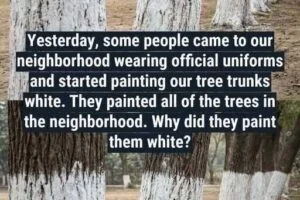
Many people notice trees with white-painted trunks and assume it’s a decorative choice, something meant to make a garden or street look neat and uniform. It’s an easy conclusion to reach — after all, the color stands out, and we often connect visible changes in nature with human aesthetics.
But the white paint isn’t about appearance.
It’s about protection.
Trees live fully exposed to their environment. They cannot shift into shade when the sun is harsh or retreat from cold when temperatures drop suddenly. Through every season, their bark absorbs heat, releases it, and quietly bears the stress of constant change. Over time, those shifts can cause real damage.
One of the biggest threats in colder months is something called sunscald. On bright winter days, sunlight warms the side of a tree trunk that faces the sun. When evening comes and temperatures fall quickly, that warmed bark cools too fast. The repeated cycle of warming and rapid cooling makes the bark expand and contract until it weakens, cracks, or splits. Beneath the bark lies the cambium — the living layer that carries water and nutrients. When it’s injured, the tree becomes vulnerable to disease, insects, and long-term decline.
White paint helps by doing something simple and gentle: it reflects sunlight.
Instead of absorbing heat the way dark bark does, the white surface keeps the trunk cooler and more stable throughout the day. This reduces the sharp temperature swings that cause cracking. It doesn’t seal the tree or interfere with its natural breathing when the proper paint is used — typically diluted, water-based white latex. The goal isn’t to coat heavily, but to soften the stress the tree endures.
Young trees benefit the most. Their bark is thinner and less protected, making them especially sensitive to sunscald. Fruit trees, newly planted trees, and those standing in open, sunny areas are common candidates. Older trees with thick bark usually manage better on their own, though even they may need help in harsh climates.
The painted area normally runs from the base of the trunk up to the first main branches — the section most exposed to sunlight and temperature shifts. In many places, a single application before winter is enough for the year.
It’s important not to confuse white paint with other markings sometimes seen on trees. Bright colors like orange often signal removal or maintenance plans. Purple frequently marks property boundaries or no-trespassing zones in certain regions. White paint, by contrast, isn’t a message to people at all. It’s a quiet act of care for the tree itself.
There can be small side benefits too. The lighter surface may discourage some insects, and rodents are sometimes less attracted to cooler bark during winter. In orchards and farms, healthier trunks often mean stronger growth and better harvests over time.
What makes this practice meaningful is how modest it is. No complex technology. No heavy intervention. Just a simple adjustment that works with nature rather than against it. A thin layer of paint can spare a tree years of stress and prevent damage that would otherwise accumulate silently.
In cities, white-painted trunks are often part of regular tree-care programs. Urban trees already struggle with reflected heat from pavement, compacted soil, pollution, and limited space for roots. Winter sunscald can be harsher in these environments, and the paint becomes one small way of easing the burden.
Used responsibly — with non-toxic, breathable paint and without overcoating — it doesn’t harm the tree. It supports it.
So when you see a trunk brushed white, it isn’t about making nature look tidy. It’s a sign that someone noticed vulnerability and chose to protect rather than ignore it.
A small act.
A steady one.
The kind that quietly preserves life instead of drawing attention to itself.
Sometimes care doesn’t look dramatic.
It simply looks thoughtful.
And often, it’s these quiet protections that allow living things to endure the hardest seasons and keep growing long after.