Hey everyone — I’m Caleb. I’m 31, and I’m writing this because I wish someone had grabbed me by the shoulders years ago and said, Stop. Pick up the phone. Go see him.
My grandpa Arthur raised me after my parents died in a car accident when I was seven. I don’t have many clear memories of my mom and dad — just flashes. My mother’s perfume when she hugged me. My dad’s laugh coming from the garage when he was elbow-deep in an old engine.
But Grandpa Arthur? He’s the reason I made it.
He was gruff and old-school. Firm handshakes. Hard work. The kind of man who believed you showed up early, said what you meant, and didn’t waste food. He drank his coffee black and strong and sat on the porch every morning in the same wooden chair like it was his post.
“Morning, sleepyhead,” he’d say when I wandered out in my pajamas, hair sticking up. Then he’d ruffle my head like I was still small enough to fit under his arm. “Ready for another adventure?”
And we had them — real ones. He taught me to fish in the creek behind the house, patient as a saint even when I kept casting into weeds. He made gardening feel like a secret mission. He’d kneel in the dirt beside me, handing me a trowel like it was something important.
“Plants are like people, Caleb,” he’d say. “They all need different things to grow. Your job is to pay attention.”
But the best part was the porch at night. After dinner, we’d sit out there while the sun drained out of the sky, and Grandpa would tell stories. Family stories. Stories about his own childhood. Stories about nothing, really — except the way he could make the world feel safe and solid with just his voice.
Those years were gold. That little house with the creaky floors and faded wallpaper wasn’t fancy, but it was home in the purest sense.
Then I turned seventeen.
And something in me shifted — not all at once, more like a slow embarrassment I didn’t want to admit. My friends had younger parents with newer cars. Their houses didn’t smell like old wood and mothballs. They didn’t have an ancient pickup truck that coughed and rattled like it was held together by Grandpa’s stubbornness.
So I started pulling away in small, cowardly ways.
When friends wanted to come over, I suggested we meet somewhere else. When Grandpa picked me up from school, I asked him to drop me off a block away. I told myself it wasn’t a big deal — just teenage stuff.
But the truth? I was ashamed of the life that had saved me.
When I left for college, the distance became easier. Convenient. Like I could pretend I wasn’t abandoning someone who had never once abandoned me.
And then it became a pattern.
Every year on June 6, my phone would ring.
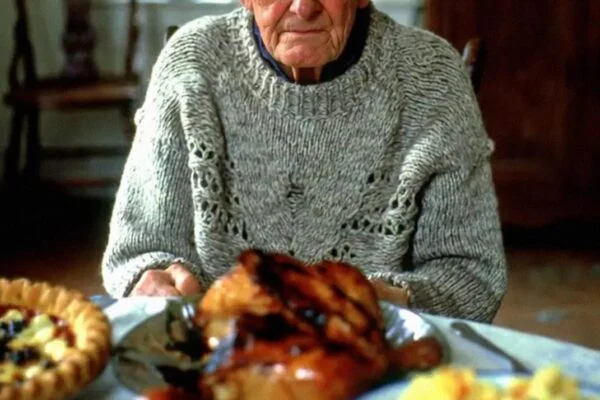
“Caleb, son,” Grandpa would say, voice warm and proud like I was still the boy in pajamas on the porch. “It’s your old grandpa. Just wanted to invite you over for my birthday dinner. Made your favorite pot roast. Hope you can make it.”
And every year, I had an excuse ready like a reflex.
Finals. Work. A trip. A girlfriend’s family thing. A “big presentation.” Something always more urgent than one evening with the man who raised me.
“Sorry, Grandpa,” I’d text back. “Super busy. Maybe next time.”
Eleven years. Eleven birthday dinners I didn’t show up for. Eleven times he made pot roast anyway, hoping I might change my mind.
I built what I thought was a successful adult life. City job. Nice apartment. Busy calendar. The kind of life people point at and say, “You’re doing great.”
But every June 6, when his number showed up, something twisted in my stomach. Because no matter how I dressed it up, I knew what I was doing.
Then this past June… the call never came.
No voicemail. No “old grandpa” joke. No invitation. Just silence.
At first, I felt a disgusting flicker of relief — like, thank God, I don’t have to come up with another lie.
And then the relief turned into panic so sharp it made me feel sick.
I told myself he was probably fine. Maybe he forgot. Maybe he was mad. Maybe he’d finally gotten tired of trying.
But the longer the silence stretched, the heavier it became. It followed me into meetings. It sat on my chest at night. I’d pick up my phone to call him, then put it down again.
What would I even say?
“Hey Grandpa… why didn’t you invite me to your birthday?”
Pathetic.
Late July, I finally snapped. On a Saturday morning, I threw clothes into a bag, grabbed my keys, and drove the two hours back to the small town I hadn’t visited in years.
I didn’t call ahead. I didn’t plan. I just drove, gripping the steering wheel like I could steer myself back into being the person I used to be.
As soon as I turned onto the dusty road that led to his house, nostalgia hit me so hard I actually blinked like my eyes were playing tricks. I remembered riding my bike down that road. Coming home and seeing him waiting on the porch, lemonade sweating in a glass. I remembered the feeling of almost home — that warm certainty that no matter what happened, Grandpa Arthur would be there.
Then the house came into view.
And my body went cold.
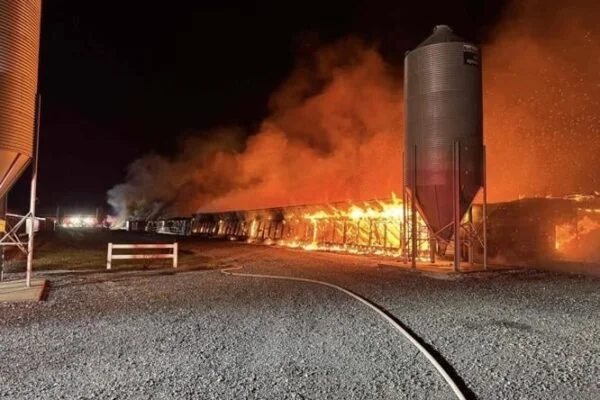
The white siding was stained black, like someone had dragged smoke across it with their hands. Windows were shattered. Glass was scattered across the front yard like sharp confetti. Part of the roof had caved in, beams exposed like broken bones.
I pulled into the driveway and just sat there, frozen, staring at what used to be my childhood.
My heart didn’t race at first. It stalled — like it didn’t know how to beat around what I was seeing.
I got out of the car on legs that didn’t feel like mine and walked toward the porch.
The steps were charred and partially collapsed. Grandpa’s wooden chair — his chair — was gone.
And then the smell hit me. Ash. Scorched wood. Something metallic underneath it that made my throat tighten, like my body knew before my brain did that something terrible had happened here.
“Grandpa?” I called out, voice cracking. “Grandpa, are you here?”
Only the wind answered, whistling through broken glass.
The front door hung open, twisted on its hinges. I stepped closer, trying to see inside, and the devastation gutted me. The house didn’t look abandoned. It looked… violated.
“Grandpa!” I yelled, panic finally detonating. “Where are you?”
Nothing.
That’s when a hand touched my shoulder — gentle, but firm enough to stop me from stumbling forward.
I spun around so fast I nearly lost my balance.
“Easy, son,” a calm voice said.
Mrs. Harlow. Grandpa’s next-door neighbor.
She looked older than I remembered, hair fully white now, but her eyes were the same — kind, steady, and sharp enough to see right through me.
“Mrs. Harlow,” I choked out. “What happened? Where’s Grandpa? Is he—”
“He’s alive,” she said quickly, like she could see my fear trying to swallow me whole. “But you didn’t know, did you? About the fire.”
I just stared at her, words stuck somewhere behind my ribs.
“It was three months ago,” she continued softly. “Electrical, they think. Started in the kitchen late at night. Your grandpa… he almost didn’t make it out.”
My knees actually went weak.
“But he’s okay?” I asked, voice shaking. “He’s really okay?”
“He’s been in the hospital since then,” she said. “Smoke inhalation. Burns on his hands and arms. He’s recovering, but… Caleb, he’s not as strong as he used to be.”
Then she said the sentence that still makes my stomach flip when I remember it.
“The hospital tried to reach you. They called your number. Over and over. Your grandpa listed you as his emergency contact.” She paused, and her voice lowered. “When no one answered…”
The unknown numbers.
All those calls I’d ignored. The voicemails I didn’t bother checking because I was “busy.” The times I saw an unfamiliar area code and let it ring out while I kept living my shiny little life.
They weren’t spam.
They were people trying to tell me my grandfather was fighting for his life.
My mouth went dry. “Oh God,” I whispered, covering my face. “I ignored them. I ignored all of them.”
Mrs. Harlow didn’t scold me. That somehow felt worse. She just sighed, like she’d been carrying this sadness for months.
“He never stopped asking about you,” she said. “Even when he was barely awake, he kept saying your name. Nurses told me he’d ask if his grandson was coming.”
It felt like drowning in guilt. Not the abstract kind you can shrug off — the kind that locks its hands around your throat.
“Can I see him?” I managed.
Mrs. Harlow nodded immediately. “That’s what he’s been waiting for.”
Before we left, she led me carefully through what remained of the house. Inside was worse than outside. The kitchen where he’d made pot roast and pancakes and my birthday cakes was destroyed. Blackened. Melted. The living room where we watched old Westerns was just charred shapes and broken memories.
And then, in the back bedroom, partially shielded by a fallen beam, I saw a small wooden box — Grandpa’s memory box.
Mrs. Harlow reached for it like it was something sacred.
“He asked the firefighters to save this,” she said. “Told them it was the most important thing in the house.”
She opened it, and it felt like someone punched the air out of my lungs.
Photos. Dozens of them. Pictures of my parents I’d never seen. Pictures of me as a kid — muddy knees, missing teeth, laughing so hard my eyes were squeezed shut. Pictures of Grandpa and me fishing, gardening, holding up a sad-looking pie we baked together.
And at the bottom…
Birthday cards.
Cards I’d mailed instead of visiting. Cards with quick signatures. Cards that should’ve meant I’m busy more than I care.
He’d kept every single one.
“He reads those when he misses you,” Mrs. Harlow said quietly. “Which is most days.”
I couldn’t speak. I just swallowed the ache in my throat and followed her to the hospital like my body was moving on instinct.
The hallways smelled like disinfectant. Clean and sharp, the opposite of smoke — and yet I swear I could still smell smoke in my hair, like the house had branded me.
Room 237.
Mrs. Harlow tapped on the frame. “Arthur? There’s someone here to see you.”
I stepped inside.
My grandfather looked smaller than I remembered, thinner, his skin papery, bandages wrapping his arms. The man who used to feel unbreakable — who could lift me with one arm and carry groceries with the other — looked fragile in a way I wasn’t ready for.
But the second his eyes landed on me, something changed. They brightened like someone had turned on a light inside him.
“Caleb,” he whispered, voice rough. “You came. You actually came.”
I crossed the room like I was afraid he’d disappear if I didn’t move fast enough. Tears were already spilling down my face.
“I’m so sorry,” I choked out. “I’m so, so sorry. I should’ve been here. I should’ve answered. I should’ve—”
His unbandaged hand found mine. His grip was weaker, but it was still his.
“You’re here now,” he said simply. “That’s all that matters.”
And that’s the thing that will haunt me forever, too — how easily he forgave me the moment I showed up.
I stayed. For the next week, I barely left his side. I listened to stories I’d been too busy for. I asked questions about my parents. About our family. About his childhood. He told me he’d been writing things down for years, keeping a journal of memories because he didn’t want our family’s story to vanish.
“Some things are worth preserving,” he said one afternoon, staring out the hospital window. “Stories. Love. The small things you think you’ll remember forever… you won’t, unless you hold onto them.”
I nodded, throat tight, because I understood what he wasn’t saying out loud.
I had almost let him die twice.
Once in the fire.
And once in the way people die when no one shows up anymore.
Grandpa Arthur doesn’t live in that house now. He’s in a small apartment near the hospital while he rebuilds — body first, life second. I visit every weekend. Not out of obligation. Not out of guilt, though guilt still lives in me.
I visit because I finally learned what I should’ve known all along: you don’t “get back to” the people who love you like that. You don’t treat them like they’ll always be waiting on the porch.
And every June 6?
I’m there. No excuses. No “maybe next time.” No pretending I’m too busy for the man who gave me a life.
If you’re reading this and you’ve been ignoring calls from someone who raised you, loved you, carried you — pick up. Go. Don’t wait for the silence that comes when they can’t call anymore.
I thought I had time.
I almost learned the hard way that time doesn’t care what you assume.
Get alerts for our most viral and important stories.