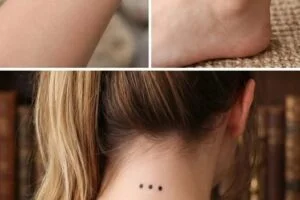
While modern interpretations often focus on personal philosophy or social identity, the three-dot motif has a long and varied history in visual symbolism. Dots and clusters of dots have appeared in art, religious iconography, and cultural markings for centuries. In some traditions, three dots represented the balance between mind, body, and spirit, or the harmony of past, present, and future. This historical resonance may unconsciously influence how people perceive or adopt the tattoo today, even when the wearer’s intent is entirely contemporary.
In other cases, the three-dot arrangement aligns with universal concepts of “triads” that are found across cultures. Triads often symbolize completeness or progression—think of trinities in religious systems, storytelling structures like beginning-middle-end, or even philosophical triads in ethics or reasoning. The simplicity of three points allows for flexibility: each dot can carry individual meaning, but together, they form a unified statement.
Personal Expression and Storytelling
For many, the three-dot tattoo is less about symbolism handed down by culture and more about storytelling. It can be a quiet autobiography etched onto the skin, marking survival through difficult periods, acts of courage, or milestones of personal growth. The minimalist design encourages introspection, prompting both the wearer and the observer to consider what might lie beneath the surface.
Some choose the three dots to represent family bonds, friendships, or other relationships that define their lives. In this way, the tattoo becomes a personal talisman—a small, enduring reminder of connections that anchor the individual in their world. The dots are both discreet and potent, demonstrating that even small symbols can convey layered meaning without overwhelming visual complexity.
Modern Interpretations and Subculture Connections
In contemporary society, tattoos often serve as codes or identifiers within subcultures, and the three-dot tattoo is no exception. While it is crucial to avoid oversimplification or stereotyping, it is true that some groups may use the symbol to signify loyalty, affiliation, or shared experience. These associations vary widely and can be deeply contextual. For example, a tattoo on a hand may indicate visibility and pride, while a placement behind the ear or on the ankle may reflect intimacy and privacy.
The diversity of meaning demonstrates a key principle: a symbol is not static. Its interpretation is shaped by environment, culture, and personal history. A single design can simultaneously serve as a philosophical statement, a nod to a community, and a deeply private reminder of an individual journey.
Navigating Public Perception
Because tattoos are visible expressions, they are subject to interpretation by others. Misunderstandings can occur when observers rely on assumptions instead of context, particularly with symbols that carry multiple or conflicting meanings. The three-dot tattoo, in its subtlety, challenges people to approach it with curiosity rather than judgment. It is a reminder that personal expression is rarely one-dimensional and that identity cannot be distilled into a single reading.
The Enduring Power of Minimalism
Ultimately, the three-dot tattoo’s appeal lies in its minimalism. It embodies the idea that meaning does not need to be ostentatious to be profound. Its simplicity allows it to transcend trends, making it relevant across generations and cultural boundaries. This adaptability ensures longevity; as the wearer’s life evolves, the tattoo’s significance can evolve as well. It is not bound by time or circumstance, but rather shaped by lived experience.
Reflection and Introspection
For the wearer, the three-dot tattoo offers a space for reflection. It encourages mindfulness, an acknowledgment of personal history, and a recognition of connections with others. Its understated presence is a quiet assertion that even the smallest gestures—physical or symbolic—can carry enormous significance.
In a world that often prizes bold statements, the three-dot tattoo demonstrates the power of restraint. It communicates depth through simplicity, inviting both introspection and interpretation. The dots are not merely ink on skin—they are markers of thought, identity, and resilience.
Conclusion
Whether representing philosophical restraint, personal milestones, social belonging, or a combination of all three, the three-dot tattoo exemplifies the enduring power of symbols. It proves that expression does not require complexity, and that even a small mark can carry a narrative as rich as life itself. Its subtlety allows it to remain intimate and personal, while its universal potential ensures that it continues to resonate across diverse contexts.
In the end, the three dots are more than a design—they are a quiet testament to the human desire to communicate meaning, tell stories, and honor identity in ways that endure beyond words.
Three Dots as a Reflection of Personal Journey
One of the most compelling aspects of the three-dot tattoo is its ability to encapsulate a personal journey in a minimalist form. Each dot can represent a distinct chapter of life, whether that involves past challenges, present experiences, or future aspirations. This triadic structure is flexible: one wearer may use it to commemorate resilience through hardship, another to symbolize personal growth, and yet another to honor relationships that have shaped their identity.
In this sense, the tattoo becomes a visual diary. Unlike more elaborate tattoos, which may tell a story in layers of imagery, the three-dot design leaves room for imagination and interpretation. Its simplicity allows it to serve as both a reminder to the wearer and a subtle invitation for conversation with others. The beauty lies in what is unsaid—the gaps between the dots echo the spaces in our lives where growth, change, and reflection occur.
Connection to Philosophy and Mindfulness
The philosophy behind the “Three Wise Monkeys” is one of the most well-known interpretations of the three-dot tattoo. The principle of “see no evil, hear no evil, speak no evil” reflects intentional restraint and mindfulness in daily life. For some wearers, it is a personal mantra: a way to remind themselves to avoid negativity, remain calm in the face of provocation, or prioritize thoughtful communication.
This philosophical connection extends beyond superstition or aesthetic appeal. It becomes a daily practice, a visual cue to pause, reflect, and make conscious choices. In a world dominated by constant information and reaction, a simple tattoo on the hand, wrist, or even behind the ear can be a grounding tool—something small that has a large psychological impact.
Cultural Variations and Social Context
Across different societies, the three-dot tattoo carries varying connotations. In some regions, it is purely philosophical, tied to concepts of restraint, balance, and personal growth. In others, it may signal affiliation with particular social groups, subcultures, or shared experiences. This duality highlights the importance of context: the same symbol can be simultaneously private and public, personal and social.
The placement of the tattoo often communicates intent as clearly as the dots themselves. A tattoo on the knuckles or the hand may indicate openness, a desire to share meaning with the world, or even pride in one’s journey. In contrast, a placement on the ankle, behind the ear, or along the side of the torso may reflect privacy—a personal reminder not meant for constant observation. This interplay between visibility and concealment underscores the adaptability of the symbol.
Misconceptions and the Importance of Context
Because of its varied interpretations, the three-dot tattoo can sometimes lead to misunderstandings. Its association with certain subcultures has caused assumptions about wearers, even when the tattoo’s meaning is entirely personal. This highlights a broader lesson about symbolism: context matters. Symbols are never neutral, and their interpretation is shaped by the viewer’s experience, culture, and perspective.
For the wearer, this can be both empowering and challenging. Empowering because the tattoo is a personal statement, independent of external judgment; challenging because others may project assumptions onto it. This tension reinforces the tattoo’s role as a conversation starter and a reflection of individual agency in shaping identity.
Minimalism as an Enduring Statement
Part of the enduring appeal of the three-dot tattoo is its minimalism. In a culture that often equates complexity with significance, its simplicity is a statement in itself. It proves that depth does not require elaboration, and that subtlety can be as powerful as grand designs.
Minimalism also allows the tattoo to evolve over time. Life experiences can imbue the three dots with new meaning, transforming them from a philosophical statement to a memorial, a symbol of survival, or a reminder of personal growth. Unlike elaborate tattoos, which may be tied to a specific time or aesthetic trend, the three-dot tattoo grows with the wearer. Its permanence is not only physical but symbolic, adapting alongside the person who wears it.
Psychological and Emotional Dimensions
Psychologically, the three-dot tattoo can function as a tool for mindfulness and emotional grounding. By serving as a constant visual cue, it encourages reflection and intentionality. For individuals navigating trauma, loss, or periods of uncertainty, the tattoo may provide a sense of stability and continuity. Its presence on the body is a daily affirmation of resilience, agency, and self-expression.
Emotionally, the tattoo carries both private and shared significance. It may commemorate loved ones, honor personal achievements, or mark moments of transformation. For some, it is a quiet tribute to survival; for others, it represents the ongoing journey of life. The simplicity allows the emotional depth to remain unspoken, yet deeply felt.
Symbols as Living Entities
The three-dot tattoo exemplifies how symbols are living entities. They are not static; their significance changes as the wearer’s life unfolds. One day, they may represent philosophical discipline; another day, they may evoke memories of a transformative event or a meaningful relationship. This fluidity ensures the tattoo remains relevant and resonant, reflecting the evolving nature of human identity.
Conclusion: The Power of Simplicity
Ultimately, the three-dot tattoo is more than just an arrangement of ink on skin. It is a reflection of human experience—personal, philosophical, and social. Its simplicity belies its complexity, allowing wearers to express layered meanings without elaborate designs. The dots serve as markers of identity, resilience, and reflection, proving that minimalism can carry profound significance.
Whether it symbolizes a personal philosophy, commemorates life events, or represents connection to a community, the three-dot tattoo endures because it adapts, evolves, and resonates. In its quiet form, it communicates the power of restraint, the depth of personal journey, and the capacity for symbols to carry meaning far beyond their physical size. It is a testament to how even the smallest marks can leave lasting impressions on both the wearer and those who encounter them.